1. What This Career Route Involves
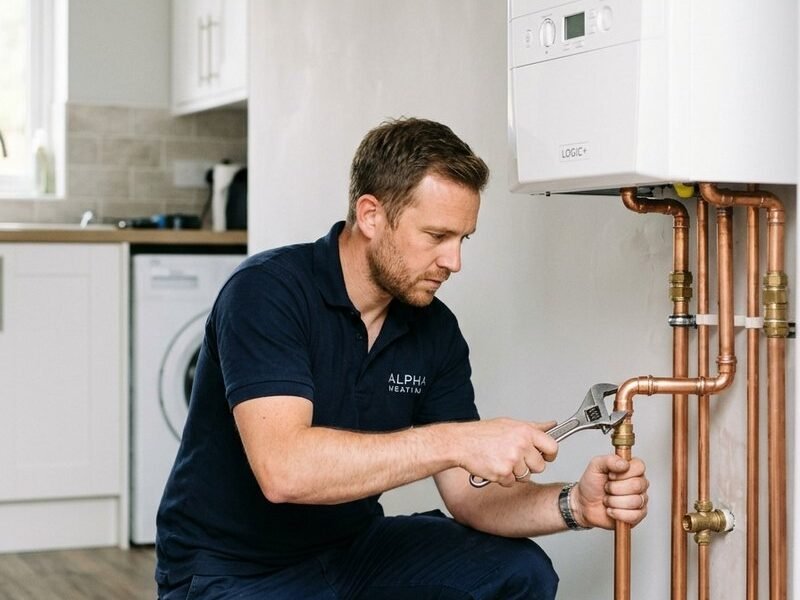
Plumbers install, maintain and repair the systems that keep buildings working: hot and cold water, central heating, boilers, bathrooms, drainage and, increasingly, heat pumps and other low-carbon heating. It is hands-on, physical work, mostly in people’s homes and on commercial sites, and no two days are quite the same — one morning might be fitting a bathroom, the afternoon tracing a leak behind a wall. Qualified plumbers are in short supply across the UK, which is why the trade has stayed well paid even as other skilled work has squeezed.
The trade is splitting in an interesting way. Traditional plumbing — pipework, bathrooms, drainage — is still the core of the job. But the growth is in heating: gas boilers, unvented hot water systems and, as the country moves away from gas, air source heat pumps. A plumber who can do both plumbing and heating, and who holds Gas Safe registration, earns substantially more than one who does plumbing alone. That is the single most important career decision in this guide, and it is covered in section 3. Read our plumber salary guide for what the pay looks like at each stage, or browse more routes inside How To Become.
2. UK Entry Qualifications Needed
There is no single school-leaving requirement for plumbing, which is part of its appeal. For an apprenticeship, employers typically ask for GCSE maths and English at grade 4 or above — the apprenticeship standard itself requires English and maths at Level 2 by the time you take your end-point assessment, so if you do not have them you will study for them alongside the trade. Beyond that, employers set their own criteria, and attitude matters as much as grades: turning up on time, working tidily in customers’ homes and being willing to spend four years learning a trade.
Adult career changers have a different starting point. You can enrol at a further education college for a Level 2 Diploma in Plumbing Studies (the City & Guilds 6035 is the widely recognised one) with few formal entry requirements beyond basic maths and English. The diploma teaches the theory and workshop skills, but it is not a licence to work unsupervised — to be a fully qualified plumber you still need the site-assessed NVQ, which means logging real jobs on real sites under supervision. That is the step people miss, and it is why short courses alone are not enough (see the FAQ below).
3. Step-by-Step Training & Qualification Pathway
There are two main ways in, plus the gas qualification that transforms your earning power. All of them are real routes — none is a shortcut.
Route A · Apprenticeship (48 months)
The Level 3 Plumbing and Domestic Heating Technician apprenticeship (standard ST0303) is the gold-standard route. It typically takes 48 months: four days a week paid on site with an employer, one day a week at college. You complete a Level 3 Diploma in Plumbing and Domestic Heating, then a graded end-point assessment (pass, merit or distinction). On completion you meet the requirements for registration as an Engineering Technician (EngTech) through the Chartered Institute of Plumbing and Heating Engineering (CIPHE), and you qualify for a CSCS card through the Joint Industry Board for Plumbing and Mechanical Engineering Services (JIB-PMES). Maximum government funding for the training is £22,000.
Route B · Adult switch via college (2–4 years)
Complete a Level 2 Diploma at an FE college, then work as a plumber’s mate while you build an on-site portfolio for the NVQ Level 2, and then the NVQ Level 3. This is the route most career changers take. It is slower to full qualification than the apprenticeship and you fund the college part yourself, but you can work and earn while you build the portfolio.
Step 3 · Gas Safe registration
To work on gas, you must be on the Gas Safe Register — it is a legal requirement, not a nice-to-have. The path is a Managed Learning Programme (or the gas element of your apprenticeship), a supervised gas work portfolio, then the ACS assessments: CCN1 (Core Domestic Gas Safety) plus appliance modules such as CENWAT for boilers and water heaters. Pass those, register with Gas Safe, and you can legally install and service gas appliances. ACS assessments must be renewed every five years.
Two add-ons are worth planning for once you are qualified. The G3 unvented hot water qualification lets you install unvented cylinders, which are now standard in most new homes. Heat pump installation training is the growth area: as gas boilers are phased down, plumbers who can install and service air source heat pumps are the ones with full order books. Neither is required on day one, but both pay for themselves quickly.
4. Training Duration & Costs
Typical Duration: 48 Months (Level 3 apprenticeship) · 2–4 Years (adult college + NVQ route) · Typical Funding / Cost: £0 tuition on apprenticeship; college diplomas vary
Apprenticeships cost you nothing in tuition — the employer and the government fund the training, up to £22,000 for the Level 3 standard — and you are paid a wage throughout. Apprentice wages start at the apprentice rate and rise as you progress; many plumbing employers pay well above the minimum because good apprentices are hard to find. The adult college route is different: a Level 2 diploma typically costs £1,500–£4,500 depending on the college, and the NVQ assessment stage has its own fees. Adults aged 19 and over can often cover college fees with an Advanced Learner Loan.
The gas route has its own costs: a Managed Learning Programme plus ACS assessments runs into the low thousands if you pay for it yourself, though many employers fund it. Gas Safe registration itself carries an annual fee of around £235 per engineer. None of these are small sums, which is why the apprenticeship — free training plus a wage — remains the best financial deal in the trade by a wide margin. If you are over 25 and considering the college route, get written quotes from two or three colleges before committing.
5. Where & How to Apply in the UK
For apprenticeships, start with the government’s Find an Apprenticeship service, where plumbing apprenticeships are listed by employers across the country, and check JTL — the training provider that handles a large share of building services apprenticeships — alongside your local FE college. The best apprenticeships are competitive, so apply to several employers and be ready to start at the bottom: employers want to see that you will turn up, listen and work tidily, and a short spell of work experience with a local plumber (even unpaid, for a week) makes an application stand out.
For the adult college route, apply directly to your local further education college for the Level 2 Diploma, and ask the college how its students find the site placements needed for the NVQ — some colleges have employer links, others leave it to you, and that difference matters more than the course brochure suggests. For gas training, use approved ACS assessment centres (your college or a specialist provider such as BPEC-approved centres), and check that any private training provider you consider is genuinely approved before paying anything. The Chartered Institute of Plumbing and Heating Engineering (CIPHE) is the professional body for the trade and a good first port of call for impartial advice.
6. Pay During Training vs After Qualification
Apprentices are paid from day one, at the apprentice rate of the National Minimum Wage as a minimum, with most plumbing employers paying more and raising the wage each year of the apprenticeship. College students on the adult route earn nothing while they study, which is the main financial reason the apprenticeship is the better deal if you can get a place.
Once qualified, the numbers are solid. The ONS Annual Survey of Hours and Earnings (ASHE 2026, provisional) puts the median gross annual pay for plumbers and heating and ventilating installers at £39,179; in the 2025 survey the middle half of the trade earned between £31,656 and £45,451. Those are employee figures, and they understate what many plumbers actually take home: self-employed plumbers charge by the job, and Gas Safe–registered heating engineers commonly see advertised salaries of £45,000–£65,000, with the top end going to engineers who do boiler installations and emergency call-outs. London and the South East pay more than the rest of the country, and self-employed plumbers who build a local reputation can exceed employed pay by a wide margin — at the cost of finding their own work and covering their own van, tools and insurance. For the full breakdown, see our plumber salary guide.
7. Long-Term UK Career Progression
The ladder in plumbing is short and practical. Apprentice, then qualified plumber, then Gas Safe heating engineer, then a choice: specialise or go independent. Specialists move into renewable heating — heat pump installation is the fastest-growing part of the trade — or into commercial plumbing, underfloor heating or bathroom design. The independent route means running your own firm: van, tools, insurance, Gas Safe registration in your own name, and a customer base built on word of mouth. Many plumbers do a bit of both, employed part of the week and taking private jobs on the side once qualified (with their employer’s agreement).
Formal recognition helps at every stage. Completing the Level 3 apprenticeship qualifies you for Engineering Technician (EngTech) registration through CIPHE, and the JIB-PMES CSCS card is what gets you onto commercial sites. Experienced plumbers can move into estimating, project management or teaching the trade at a college. The work is physical, but a skilled plumber with a good local reputation is rarely short of work.
Recommended Next Reads: How much does a plumber earn in the UK? · How much does an electrician earn in the UK? · Highest-paying jobs in the UK with no degree
8. Frequently Asked Questions
Are 6-week plumbing courses enough to work as a plumber in the UK?
No. Short courses award college certificates, not the site-assessed NVQ Level 2/3 that employers and insurers ask for, and they do not lead to Gas Safe registration. They can be a useful introduction, but they are not a qualification to practise on — anyone selling a six-week course as a complete route into plumbing is overselling it.
What is the minimum age limit for a UK plumbing apprenticeship?
There is no upper age limit. Apprenticeships are open to adults of any age, and plumbers regularly retrain at 25, 35 or 45. The only age-related rule is that apprentices under 19, or in their first year, are paid the apprentice rate of the National Minimum Wage.
Do I need Gas Safe registration to be a plumber?
Only to work on gas. You can be a fully qualified plumber working on water, drainage and bathrooms without it. But gas work is where much of the money is, and it is illegal to work on gas appliances without being on the Gas Safe Register, so most plumbers get registered as soon as they can.
How long does it take to become a fully qualified plumber?
Four years on the Level 3 apprenticeship, or two to four years on the adult college-plus-NVQ route depending on how quickly you can log the on-site evidence. There is no legitimate shortcut — the NVQ requires real jobs, assessed on real sites.
9. Official UK Sources & Methodology
Cited Public Sources (November 2026)
- Skills England — Plumbing and Domestic Heating Technician Apprenticeship Standard ST0303 (48 months, Level 3)
- Find Apprenticeship Training — Plumbing and Domestic Heating Technician (Level 3), 48 months, £22,000 funding
- Gas Safe Register — Engineer Qualification Requirements and Registration
- Chartered Institute of Plumbing and Heating Engineering (CIPHE)
- ONS Annual Survey of Hours and Earnings 2026 (provisional) — median pay for plumbers and heating/ventilating installers (£39,179)
- ONS ASHE 2025 Pay Percentiles — plumbers (£31,656–£45,451, 25th–75th percentile)
Pay figures are ONS ASHE medians and ranges for employees (2026 provisional median; 2025 percentile range), verified as of November 2026. Self-employed earnings vary widely. Figures are averages and ranges, not guaranteed outcomes.
Related UK Career Guides
 £40,911
Most in-demand jobs in the UK 2026
Green-grid electricians, heat-pump plumbers, registered nurses, STEM teachers, cyber-security engineers and Class 1 HGV drivers lead UK hiring bottlenecks.
 2–3 Years On-Job
How to become a police officer in the UK
Every route — whether PCDA Apprenticeship, Degree-Holder DHEP or IPLDP+ — pays a full Constable salary (£31,164+) from Week 1.
 2-Page Standard
How to write a CV (UK format)
Unlike US 1-page resumes or European CVs with headshots, UK recruiters expect a clean 2-page A4 CV with zero photo, zero date of birth and quantified outcomes.