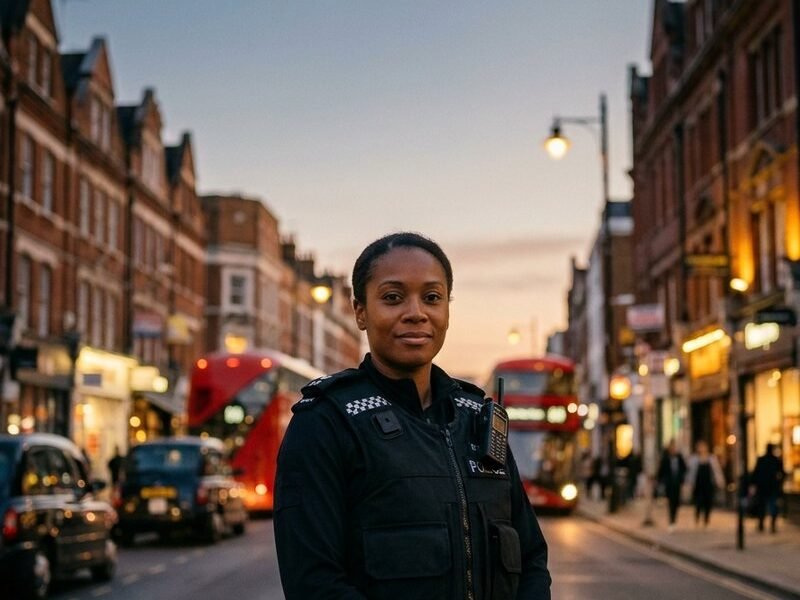
What a police constable does
Police constables are the front line of policing in the UK: responding to emergency calls, investigating crime, gathering evidence, safeguarding vulnerable people and keeping the peace on the streets. The job changes by the hour, a missing person in the morning, a road traffic collision after lunch, a domestic incident in the evening, and it is done on shifts, including nights, weekends and bank holidays, in all weathers. There are 43 territorial police forces in England and Wales, plus Police Scotland and the Police Service of Northern Ireland, so the employer is always local, but the job itself is national in shape.
It is worth being straight about what the job demands. You will deal with people on the worst days of their lives, you will write a great deal of paperwork, and you will be held to standards of conduct that follow you off duty as well as on it. In return you get a job with a national pay scale, a defined-benefit pension, a clear promotion structure and a level of variety that few other public-sector roles match. Read our police officer salary guide for the full pay scale, or browse more routes inside How To Become.
Eligibility: age, nationality, fitness and vetting
The entry requirements are specific, and it is worth checking them against your own circumstances before you invest months in an application. You must be at least 17 to apply and 18 when you are appointed, and you must be a British citizen, a citizen of a Commonwealth country or the Republic of Ireland, or have settled status in the UK. For the degree apprenticeship route you need a Level 3 qualification, two A-levels or an equivalent such as a BTEC, while the degree-holder route requires a degree in any subject. A full UK manual driving licence is usually required, either at application or by the end of your probation, and you will need to pass a medical, an eyesight test and a fitness test: level 5.4 on the 15-metre multi-stage shuttle run, the “bleep test”. That is a modest standard, a few weeks of structured running gets most people there, but it is a hard pass/fail, so train for it rather than assuming you will manage on the day.
Then there is vetting, which is the part that catches people out. Every force runs security and background checks on you and, to a degree, on people close to you. Undeclared criminal convictions, serious financial problems such as an undischarged bankruptcy or a history of defaulted debts, and drug use are all likely to be problems. Tattoos are assessed case by case: most forces now accept visible tattoos, but anything offensive, or on the face or neck, is usually a bar. If you are unsure whether something in your history will disqualify you, most forces have a recruitment team you can ask confidentially before applying.
PCDA, DHEP and the non-degree route
Since the College of Policing introduced the Policing Education Qualifications Framework, there are three main routes into the job. All three end at the same place, a police constable on probation, earning a full salary from day one, and the right one depends on what qualifications you already hold.
Route 1 · Police Constable Degree Apprenticeship: PCDA (3 years)
The main route for applicants without a degree. A three-year paid apprenticeship combining on-the-job policing with study at a partner university, ending with a degree in professional policing practice. You need a Level 3 qualification to apply, you earn a constable’s salary throughout, and you pay no tuition fees.
Route 2 · Degree Holder Entry Programme: DHEP (2 years)
For applicants who already hold a degree in any subject. A two-year programme that converts your existing degree into a Graduate Diploma in Professional Policing Practice while you work as a constable. Shorter than the PCDA because your degree already covers the academic groundwork.
Route 3 · Initial Police Learning and Development Programme: IPLDP+ (non-degree entry)
A work-based entry route for applicants with Level 3 qualifications who do not want a degree. Availability varies by force, so check whether your chosen force is currently recruiting through this route before you plan around it.
Whatever the route, the selection process follows the same shape. You apply to a force, complete the online National Sift, a series of situational judgement and reasoning exercises, then attend an assessment centre with role-plays, written exercises and an interview. After that come the fitness test, a medical, and vetting, which together can take several months. Training itself starts with classroom learning, around 18 weeks of law, procedure and practical skills, followed by tutor-paired patrol: you go out with an experienced officer who signs off your competence in stages until you are working independently. Your probation lasts for the length of your training programme, and you must complete it successfully to be confirmed in rank.
Training length and cost (you are paid from day one)
Typical Duration: 2–3 Years On-Job (PCDA 3 years · DHEP 2 years) · Typical Funding / Cost: £0 tuition: paid from day one
There are no tuition fees on any police entry route: the force pays for your training in full, and you are paid a constable’s salary from the day you join. That makes policing one of the few graduate-level careers in the UK with no student debt attached: the PCDA even ends with a degree you did not pay for. The costs you do bear are small and practical: travel to assessment centres, a driving licence if you do not already hold one, and kit such as boots (some forces provide these). The real cost is time: from application to starting training can take six to twelve months, and the training itself runs two to three years depending on the route, so this is not a quick career change.
Applying through Joining the Police
Apply through the national recruitment portal, Joining the Police (joiningthepolice.co.uk), which lists vacancies by force, or directly on your chosen force’s recruitment pages: the Metropolitan Police, West Midlands, Greater Manchester and Police Scotland all run their own campaigns. You apply to a specific force, not to policing in general, and you should think carefully about which one: forces differ in size, in the areas they cover and in how often they recruit, and moving between forces later is possible but not instant.
A strong application starts before you apply. Forces look for evidence of the behaviours policing needs, communication, teamwork, integrity, resilience, and the best way to show them is through real experience: volunteering, community work, customer-facing jobs, or anything that shows you can stay calm and fair under pressure. Some forces run insight days or ride-alongs for prospective applicants, and they are worth attending. When you do apply, be honest about your history in vetting: an old issue you declare is usually manageable; the same issue discovered later is not.
Student officer pay and what follows
There is no separate trainee rate in policing: you are a police constable earning a salary from the day you join, on the national constable scale. For officers appointed on or after 1 April 2013, the scale in force from 1 September 2025 (Home Office Circular 011/2026, Annex F to the Police Regulations 2003) runs from £31,164 at pay point 1 to £50,256 at pay point 7, rising one point a year if you meet the pay progression standard. A chief officer can choose to start all new constables on pay point 2 (£32,472) where local recruitment needs it, so the starting figure in your force’s advert is the one to go by.
London pays more on top: officers in the Metropolitan and City of London forces receive £3,150 a year in London weighting, plus a London allowance set by each Commissioner of up to £6,588 a year. Forces around London pay a South East allowance instead. A 3.5% pay award from 1 September 2026 has been confirmed by the government, which would lift the starting point to around £32,255: but the Home Office had not yet published the updated per-point determination when this guide was written, so treat the 2026/27 figure as provisional until the official table appears. Overtime, rest-day working and some specialist allowances add to basic pay, and the police pension is a defined-benefit scheme, which is worth real money over a career. For the full breakdown, see our police officer salary guide.
Staying a constable, specialising or going for sergeant
The constable rank is where everyone starts, and it is also where a large share of officers happily stay: specialist constable roles in CID, firearms, traffic, dog handling, public order and neighbourhood policing offer variety without promotion. For those who want to move up, the path is constable, then sergeant (through the National Police Promotion Framework, which involves a written exam and a work-based assessment), then inspector, chief inspector, superintendent and beyond. Detectives follow a parallel track: constables can apply for the detective pathway, usually after their probation, and qualify as detective constables through the same promotion framework.
Promotion is competitive, not automatic: you apply, you are assessed against the rank above, and you wait for a vacancy. But the structure is transparent: the ranks, the pay at each rank and the process are all published nationally. Beyond the uniformed ranks, specialist roles in intelligence, forensics, digital investigation and training are open without climbing the command ladder. A full career in policing, from constable to senior officer, can span thirty years and end on a salary well into six figures at the top ranks.
Recommended Next Reads: How much does a police officer earn in the UK? · How to become a nurse in the UK · How to write a CV (UK format)
Questions about joining the police
Do I need a degree to become a UK police officer?
No. With Level 3 qualifications (two A-levels or equivalent) you can join through the three-year paid Police Constable Degree Apprenticeship, which ends with a degree you did not pay for. The non-degree IPLDP+ route is also available in some forces. A degree only becomes necessary if you want the shorter two-year DHEP route.
How fit do you have to be for the UK police fitness test?
You must reach level 5.4 on the 15-metre multi-stage shuttle run (the bleep test). It is a modest standard, a few weeks of regular running and interval training gets most people there, but it is a hard pass/fail, so train for it before your assessment day rather than hoping for the best.
How long does the police application process take?
Commonly six to twelve months from application to starting training, with vetting and medical checks accounting for much of the wait. Forces recruit in cohorts, so your start date depends on when the next intake begins. Apply early and keep your documents ready.
Can I choose which police force to join?
Yes: you apply to a specific force. Think about where you want to live and work, the size of the force, and how often it recruits. The Metropolitan Police recruits in large numbers year-round; smaller forces recruit in smaller, less frequent intakes.
Where these facts come from
Cited Public Sources (November 2026)
- PolicePay: Student Police Officer Pay (Home Office Circular 011/2026, Annex F; constable pay point 1 £31,164 from 1 September 2025)
- SalaryCheckUK: Police Pay Scales 2026/27 (3.5% award from 1 September 2026; Police Federation scales)
- Blueline Hub: Learning & Pay (2025/26 constable scale, London weighting £3,150)
- Joining the Police: National Recruitment Portal (College of Policing)
Pay figures are the Home Office determination in force from 1 September 2025 (Circular 011/2026, Annex F). The 3.5% award from 1 September 2026 is confirmed but the updated per-point determination had not been published when this guide was written. Figures are medians and ranges, not guaranteed outcomes.
Related UK Career Guides
 1 Year PGCE
How to become a teacher in the UK
Tax-free DfE bursaries up to £28,000–£30,000 in Maths, Physics, Computing and Chemistry make postgraduate PGCE + QTS one of Britain’s best-funded career switches.
 £40,000–£76,000+
Highest-paying jobs in the UK with no degree
Air traffic controllers, commercial electricians, Gas Safe plumbers, Class 1 HGV drivers, train drivers and tech apprentices routinely out-earn graduate averages.
 2-Page Standard
How to write a CV (UK format)
Unlike US 1-page resumes or European CVs with headshots, UK recruiters expect a clean 2-page A4 CV with zero photo, zero date of birth and quantified outcomes.